Translate

Showing posts with label tent camping. Show all posts

Friday, August 19, 2022

No Particular Place to Go

(this is part two of my 2022 road trip; part one is here

Getting out and about on Friday was a struggle. 

My traveling companions

After I managed to get up, grab a bite to eat and pack up the tent, I sought out a place to fill up the gas tank and get some more ice. I found myself in a little town called Bolivar, on the Tuscarawas River. I considered going to the Fort Laurens Museum, but then for some reason decided to go to Bolivar Dam instead.
Bolivar Dam on Sandy Creek

I wandered around the path a little, and thought, "I think Pat would say this place looks fishy." I decided to look at how much a one-day out-of-state Ohio fishing license would cost, and if it was less than $20, I'd fish for a little while for the heck of it. 

It was $14. Fish on!

Looking down to the "fishy" area

Settling in, judging the best spot to cast from with minimal chance of treeing it

I started with a "ned rig" which got nothing. So I switched to a Whopper Plopper (top-water lure)

Yay! It may be little, but it was a largemouth bass on a top-water lure, so it was good.

After switching from a ned rig with a coppertreuse Z-man Finesse TRD worm to a "yoda" Whopper Plopper, I started to see interest from the small (6-8 inch) largemouth bass in the area. I finally not only enticed one to bite, but stay hooked until I could land it. 

Minutes after that, I saw feeder fish scrambling to get away from something out by the turtle basking logs in the middle of the creek. I cast in that area. 

It bit. And it fought. And I had it barely out of the water and was reaching for it when it unhooked itself and swam away. It was a chunky 16-ish (maybe larger) inch largemouth. It kept antagonizing the feeder fish while I kept trying to entice it to bite again. I tried Reaction Innovations Skinny Dipper swimbaits, went back to the Whopper Plopper, and nothing. 

More and more turtles showed up to watch the show during the two hours I was here

I'd only planned to stay maybe an hour, but that stupid fish that got away made me stay another hour trying to get it back. It was still a fun diversion, and I caught more fish than guys that showed up for 30 minutes with their catfishing gear (I caught the first fish as they were leaving and they saw me bring it in). 

From the dam, I drove south on I-77 and thought about visiting Hopewell Culture, since I hadn't been there in several years and I'd gone to Cahokia Mounds last year. Instead, when I stopped for gas outside Newark, OH, I saw a sign for the Great Circle Earthworks -- another Hopewell site -- and chose to go there instead. 
The entrance to the circle, looking directly at the Eagle Mound

Photos alone really can't do justice to this structure. The circle itself is 1200 feet in diameter, with an arrow shaped mound in the center that is called Eagle Mound. Archaeologists found the remains of a wooden structure in the mound, and think it may have been a ceremonial building that was intentionally burned and buried when the inhabitants left this site. 

Inside the circle wall is a ditch which was probably full of water when this area was inhabited. It's thought that the circle symbolized the turtle in an ocean, an Indigenous motif of the world in the universe. 
The inner ditch just inside the entrance to the circle
I was being watched while I walked around the interior of the Great Circle
 
Standing on Eagle Mound, looking towards the opening to the Circle

A nearby Hopewell site and part of the Newark Earthworks is called the Octagon. It is only somewhat open to the public because it's been leased to a country club since 1910. This actually upset me, because both the Great Circle and the Octagon were evidently sacred sites tied to the moon, and in fact may have represented the moon at perigee and apogee. Fortunately, I have since discovered that I'm not the only one disgusted and angry that an historical and sacred site (one that is part of a nomination as a UNESCO World Heritage site), and that the battle to remove the country club (has gone to the Ohio Supreme Court). Here is a NY Times article on the subject from 2021. Of course, if this truly was a lease to the country club (which, according to the article, runs through 2078), there should be provisions for ending the lease early. 


Part of the view from the viewing platform, which Moundbuilders Country Club considers "open access" to the grounds by the public.

The golfers can walk on the earthworks for a shot.
Observation Mound, from which Woodland period native peoples would have watched moonrise. This view is from the "public access" trail.

From the Octagon, I headed south through Cincinnati into Kentucky, thinking maybe I'd try Mammoth Cave in the morning. I made a reservation at a KOA in Horse Cave and set Waze to get me there. Construction on I-65 at the Horse Cave exit backed traffic up by two miles, making the trip take almost an hour longer than it should have, so I found myself putting up the tent in the dark. The Horse Cave KOA is not very tent-camper friendly, as the tent area is not flat, and is about as far away from the restrooms/showers as can be. In the dark, it was difficult to find my site, especially with no clear place to park the car. 

At least there was a little bit of firewood left in the firepit, so I started a short-lived campfire.

The next morning, I looked at Recreation.gov for cave tours at Mammoth Cave, and it looked like I wouldn't be able to get anything that I haven't done previously. I contemplated my next steps while avoiding the group of murder ducks wandering the campground, as well as a loose dog that was looking for a friend. 
Murder ducks. It's like being in Hershey all over again. 

What do you guys what to do today?

In the end, I decided to skip Mammoth Cave and go to Hidden River Cave instead. It was only about ten minutes away from the KOA, and when I got there, they waved me right into the tour. 
This is the Horse Cave, because when it was first settled, "horse" was just a term for something really big. It's now called Hidden River Cave.

The river is right at the bottom of the opening, and you follow along it a little ways before going into the other two dome rooms. This is a cave much like Mammoth in that it has domes and very few "wet" formations like stalactites, stalagmites, flows or columns. And of course, the "big sell" for Hidden River Cave is the bridge, which was more than a little nerve wracking for someone like me who doesn't like bridges. 

The hidden river

No one wanted to be the first (behind the guide) across the bridge

One of the few places of "flowstone"

Sunset Dome, the third of the three rooms on the tour

Heading back out of the cave

The American Cave Museum is part of the Hidden River Cave tour, and explains how the cave reflects an ecosystem that was nearly destroyed by the town basically using the cave as a sewer.... which then almost killed the town, since their drinking water originated from the cave. The cave had to be closed in the 1940s because of the pollution, and it was known as the most polluted cave in North America. Only after a new wastewater treatment facility was put into place nearby in 1989 did the cave ecosystem begin to recover from nearly a century of abuse. 

From Horse Cave, I meandered northward past Louisville and into Henderson, where just before crossing over the river to Evansville, IN, I saw a sign for John James Audubon State Park. I pulled in and immediately saw the Civilian Conservation Corps work. 

The Welcome Center, gift shop and museum are located here.

The museum is a paltry $6 to visit, and I would share photos, but due to copyright issues, you aren't allowed to take photos of the amazing collection of original Audubon works they have, including multiple copies of his Elephant Folio. There is also a comprehensive history of Audubon, who spent several years in Henderson, KY trying to find his way in the world. 

Of course, there were hiking trails, so I took the opportunity to stretch my legs. I saw birds, but also myriad other animals!

And fungi.... you know I saw fungi too!
A still and quiet pond

Green dragonfly, an Eastern pondhawk female

Five lined skink!

Eastern pondhawk male

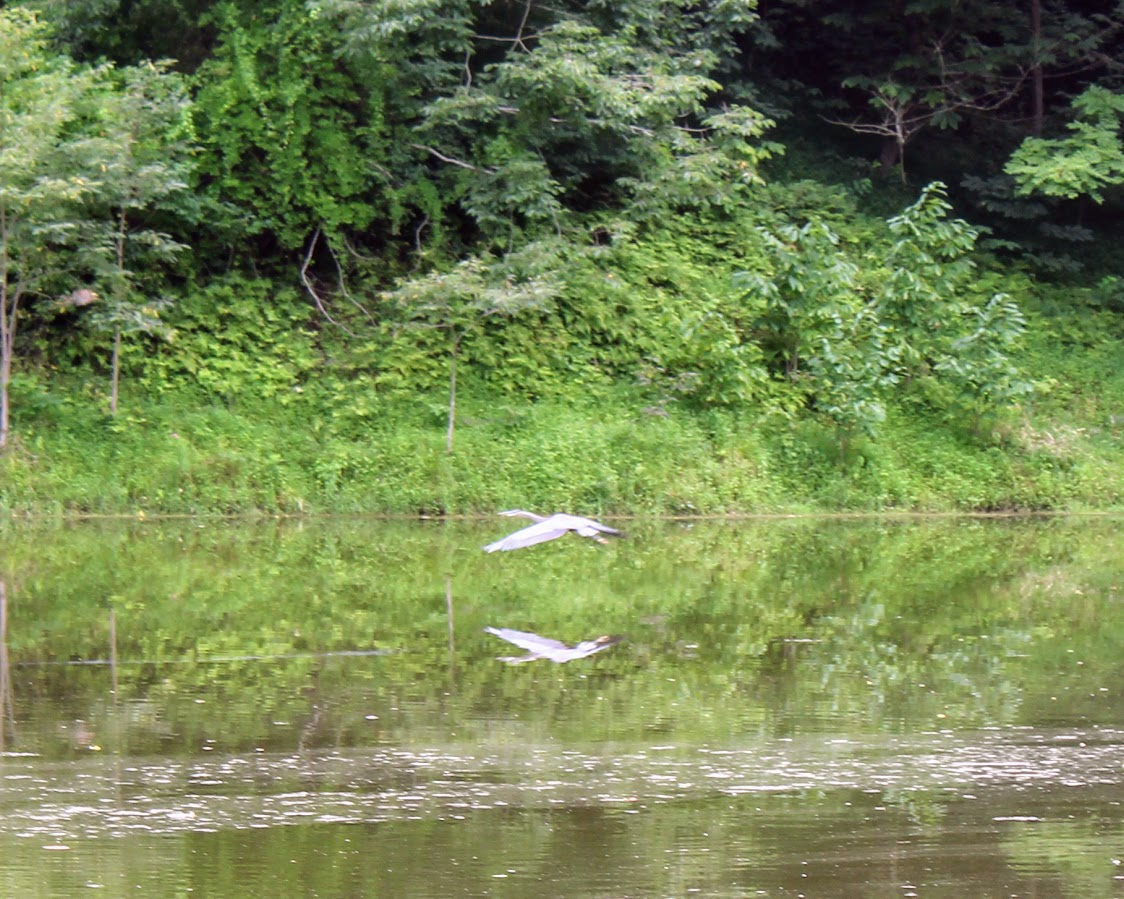
Heron

Two deer

I legitimately chastised some super loud children right after I saw these deer. They were basically yelling at each other in conversation, and I just shushed them and said, "You just scared away two deer, a duck and who knows how many turtles." The kids went silent and I continued, "You probably haven't seen anything since you're so loud. If you want to see the animals, you need to be quieter." The parents just looked at me.

I walked away (they were going in the opposite direction I was), and I didn't hear them again. 

A CCC constructed shelter, marking where the overlook spur branches from the main trail

Built in the 1930s, renovated as an Eagle Scout project in 2000, and still needs protection from vandals

Turtles basking

Plainbelly watersnake, maybe

Hummingbird sculpture based on an Audubon painting

Butterfly on a coneflower

I decided to call it quits outside St. Louis, and got a tent site at a KOA I've stayed at before. The tent sites there are okay; they are flat and somewhat close to the renovated restrooms/showers, but they are also buggy. 

Campsite for the night

Buggy campsite also means spiders

A friendly lightning bug that looks just slightly different from the Maryland variety

I cooked up some "Forever Young Mac and Cheese" for dinner, and it wasn't as good as the spicy sausage pasta. Maybe it would have been better if I had some Old Bay to put in it. I still had no itinerary besides being in Salt Lake City by next Friday, so I figured I'd just drive through St. Louis, take I-70 for a while and then either find some things in Kansas or head up towards Lincoln, NE. 

But first, sleep. 

note : some links are associate links to sites where I received minimal compensation if you make a purchase through the link

Tuesday, August 17, 2021

Road Trips in the time of COVID

Pat and I just got back from our 2021 road trip, where I started out on July 28, and he joined me in Missoula, MT. 

It was a bit less stressful than last year, and I can't help but think that a lot of the reason was because we decided to tent camp as much as possible, unlike last year, where we spent probably too many nights at hotels. 

To me, the tent camping took a few elements of the COVID transmission off the table; we weren't at the mercy of others for cleaning our sleeping quarters, and even encountering others, we were in the open air. 

A typical camp site with the Crosstrek and our tents. 

We usually drove 2-3 hours between places we stopped to visit, and so there was plenty of time to talk about things, such as "should we have bought Mom's RV?" or "maybe we should stay at a hotel?" In the end, for the two of us, tent camping made much more financial sense. 

Having done three years of road trips with my mom and her Pleasure-Way RV, I have some experience on that front, and the multiple trips to and from Packwood for the ProSolos there had me very acquainted with staying at hotels on the road. 

Here's a breakdown for 2021 :
  • Tent sites at KOA campgrounds cost $30-50. A site with water and/or electric will cost more, so if you have charger banks for electronics, use them and charge them in the car during the driving to avoid needing an outlet. A $33 KOA Rewards membership gets you 10% off, and then you accrue "points" that can get you more money off a night. I recouped the $33 membership cost with the savings in the first week of the trip, and accrued enough points to get $20 off a stay by the end of the trip. 
    • Hotel costs on the trip in 2021 were ridiculous. I got a hotel in Missoula because Pat's flight came in at 11PM, and I made that reservation two months prior to the trip. It was still $140 ($126+tax), and then the room didn't even include a fridge! (the front desk clerk said, "Oh, most of our rooms have them; I guess you got one without."). When we looked at hotels for the next night in the Bozeman/Livingston/Butte area, they started at $225+tax. Needless to say, we went with the Three Forks KOA, which was one of the best decisions of the trip. Definitely go to the Iron Horse Cafe for pie if you go through Three Forks.
    • For tent camping, make sure you have a vehicle that you can "hide out" in if necessary. The first three nights of the trip, I dealt with nasty thunderstorms, so after I set up the tent (which is waterproof), I "hid" in the Crosstrek until the worst of it had passed.  
The gluten-free Key Lime pie from Iron Horse was incredibly decadent. Pat couldn't eat all of it as dessert, and finished it for breakfast the next morning. 
  • Gas is a big cost, and probably the biggest cost difference between a tent camping road trip and an RV road trip. While both the Crosstrek and the Pleasure-Way RV take "regular" unleaded gas, the Crosstrek averages ~36 MPG (35.2MPG last year and 36.5MPG this year, both years ~7500 miles traveled, including both Rocky and Appalachian mountain crossings). The Pleasure-Way, a modified E350 chassis and engine, was 14-15MPG. At an average of $3/gal for regular gas (I did splurge one day and gave the Crosstrek mid-grade, because I wanted to reward it for its hard work in the desert heat), that adds up, fast
    • 7500 miles at 36MPG is about 208 gallons of gas. At $3/gal, that's $624 in gas alone (and I'm being nice with my averages; it was probably more than $3/gal). 
    • 7500 miles at 15MPG is about 500 gallons of gas. At the same $3/gal, that's $1500 in gas. A larger RV (my mom's Pleasure-Way was a class C and only fit two people) is probably not going to do as well mileage-wise. And a diesel motor might not help, as diesel costs were close to $4/gal, even if the MPG might be better. 
  • I went through a lot of ice in the coolers, which an RV doesn't need to worry about. I wasn't using top-of-the-line plastiformed coolers, but they are lightweight, don't take up huge space and do what I need them to do. Still, I was buying 20lb of ice each day, at about $6 per day for ice. For a 19 day trip, that comes out to about $115 in ice. 
  • RVs allow for a huge discount on food, since you don't have to eat out when you have a kitchen and a fridge with you. Tent camping means bringing things in coolers and/or using MREs or other freeze-dried options. I have a great campstove for cooking on, though I have to admit, cooking on it when there is an impending thunderstorm is a little daunting. 
Heating up some water to rehydrate a freeze-dried meal for dinner in Rawlins, WY

Walleye cooked on the campstove grill. We caught the fish at Rainy Lake.

Brats (glorified hotdogs?) on the campstove. We have the grill attachment for our Biolite, which is great.
    • Breakfast was usually a mini-bagel with cheese, and lunch was a piece of fruit, granola bar and a sandwich. You just have to make sure the cheese and any deli meat doesn't get wet in the cooler. Fruit was bananas, plums, nectarines, etc. This meal plan was true for the RV trips with mom, too. 
    • If you opt to "eat out," plan on paying upwards of $15-20/person (gratuity included, more if you get beer/wine). That's a far cry from buying a $5/pk of five brats, and a $3 loaf of bread, or even a $9 "southwest skillet" rehydrated meal (which was actually really good). 
  • Just looking at food, gas and lodging costs, a pure tent camping experience could be had for less than $2000 over 19 days/7500 miles, not counting any admission fees for parks. Mixing in a hotel night or a meal out here and there will increase that cost. Since we were fishing on Rainy Lake with a guide service as part of our trip, I'd opted to get rooms at a lodge on the lake as a bit of a splurge, but I have to admit, that walleye taco wrap at the Thunderbird Lodge is amazing
    • An RV trip over the same amount of time/miles will be about a thousand more in gas, a hundred less in ice, and about $500 more in lodging costs (depending on the size of the RV, and whether you need water/electric/dump hookups). So, estimate for 19 days to be still less than $3500.
    • A roadtrip that relies on eating out and hotels every night is going to cost at least $4200 for two people and a vehicle that can get upwards of 35MPG (regular grade gasoline). 
Some other ideas to reduce the costs :
  • Get a National Parks Pass if you plan to visit multiple parks that have entrance fees. For $80, you have unlimited entrance to all NPS and associated (BLM, National Wildlife Refuge, etc.) sites for a year. 
    • There are ways to get a free NPS pass, but you need to qualify. Students in the fourth grade qualify, as do military/veterans. If you're over 62, you can get a lifetime pass for $80, versus paying $80 annually. Certain disabilities also qualify for a free NPS pass. If you volunteer in a park and accrue more than 250 hours, you can also qualify for a free NPS pass. 
  • Plan to visit smaller, less crowded sites and "bundle them." For instance, I visited Rock Creek Station and Fort Kearny on the same Nebraska State Parks day pass, since the pass I bought at Rock Creek didn't expire until noon the next day. 
The legend of Wild Bill Hickok was born at the Rock Creek Stage Station
  • If you don't need water and electric hookups, and are willing to do the leave-no-trace principles of backcountry camping, then dispersed camping in National Forests and BLM sites is definitely an option. 
  • Sign up for cash back apps like Get Upside for discounts on gasoline purchases (note that the link here is my referral link). Note that if you use an app like this, look carefully to see what you are paying; sometimes, only the most expensive stations are participating, and so you actually aren't saving money there after all. 
  • Use a cash back app like iBotta for hotel reservations. iBotta will get you 3% cash back at Choice Hotels (Comfort Inn, Sleep Inn, Quality Inn, etc.), if you make the reservation through the iBotta extension on Chrome. Unlike something like Priceline, you can actually choose the hotel you want to stay at.
    • iBotta will get you a discount on a ton of other things, too, so it's useful for more than just road trips. The link above is my referral link, but I wouldn't refer this (or the Get Upside app) if I didn't think they were worth the time/effort.
Above all, on a road trip, be flexible. Weather and other unforeseen circumstances may cause you to change your itinerary. Look at those billboards and if something seems interesting, do it. Wall Drug isn't for everyone (I've never been there), but others find it fascinating. On the flip side, in 2012, I saw a billboard for House on the Rock, and thought, "Wait, isn't that where Shadow and Wednesday went in American Gods?" and so decided to take a detour. 
"Take Highway Fourteen west to Spring Green. We'll be meeting everyone at a place called the House on the Rock. You been there?"
-- Wednesday to Shadow, American Gods


No matter what, enjoy your trip! 
Camping in Rawlins, WY during a thunderstorm